What is supported?
Identify the evidence supporting an assessment and trace it to its source.
COMPLIANCE EVIDENCE ENGINE
Understand what the accumulated documentation supports about study conduct, where it conflicts, and what remains uncertain.
THE QUESTION BEHIND THE DOCUMENTS
Trial documentation records how a study is being—or was—conducted. Understanding it requires connecting facts across documents, people, sites and time. Missing evidence can be as important as a contradiction.
Identify the evidence supporting an assessment and trace it to its source.
Surface conflicts between sources, versions and timelines.
Make missing or insufficient evidence visible for human review.
HOW CEE WORKS
CEE combines a defined study-evidence model, deterministic controls and constrained AI reasoning. The result is a reviewable assessment connected to its supporting evidence.
Organise artefacts into profiles and structured facts.
Link entities, relationships and events over time.
Apply defined controls and AI-supported interpretation.
Present conclusions with provenance for expert assessment.
CEE IN PRACTICE
These screenshots from the CEE presentation show how an assessment is accompanied by supporting documents and made available for expert review.
CEE identifies a gap between temperature-log documents. The observation states that continuity cannot be confirmed from the available evidence; it does not establish that a temperature excursion occurred.

Product screenshot · select the image to open it at full resolution.
CEE correlates IRB/IEC approval records with protocol versions and flags a potential mismatch for review. The underlying evidence remains available to check the conclusion.
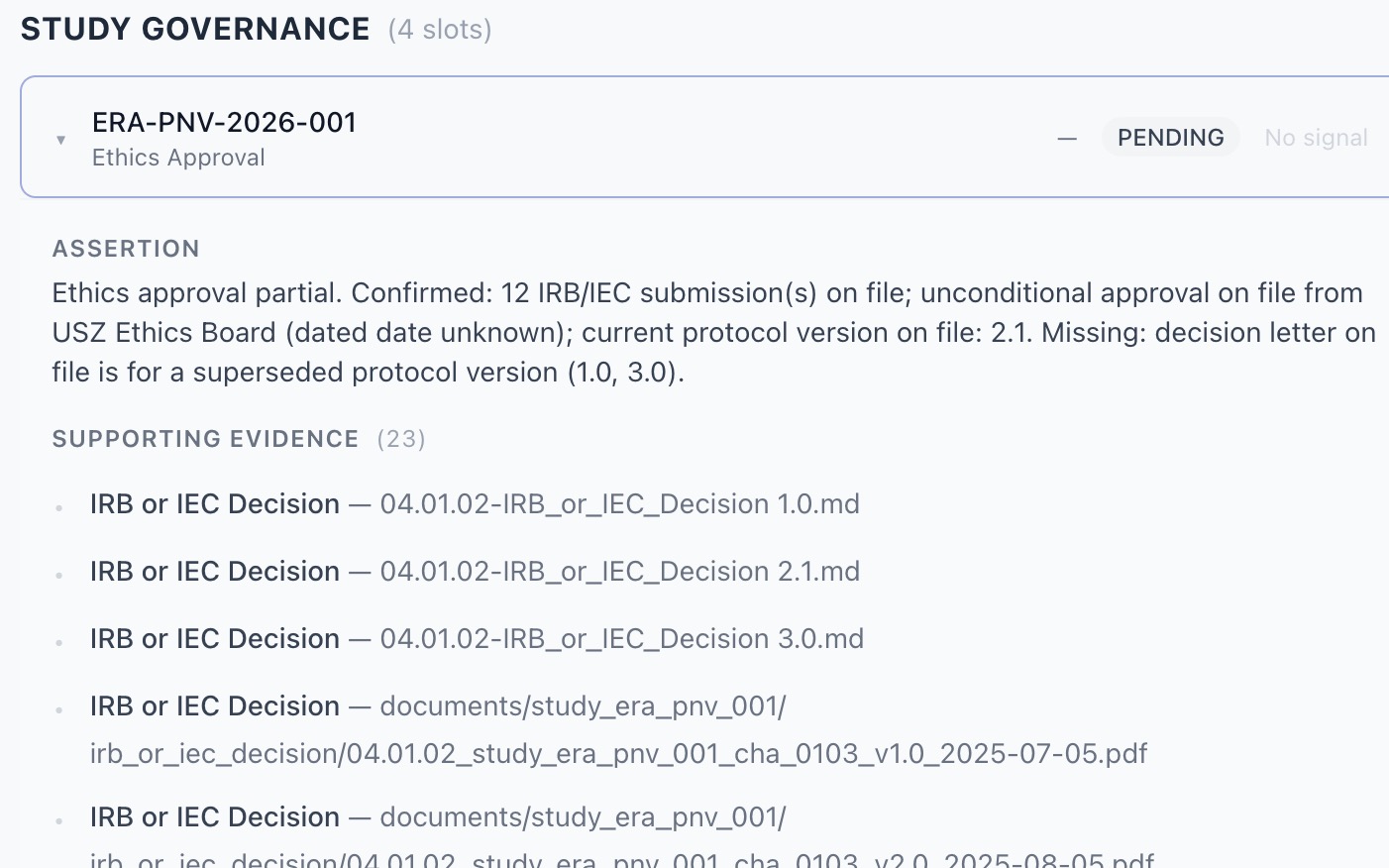
Product screenshot · select the image to open it at full resolution.
ONE EVIDENCE LAYER. TWO DECISION CONTEXTS.
Identify potential consent, qualification, governance, timing and investigational-product documentation issues. Give clinical and quality teams a traceable basis for investigating findings and addressing gaps.
Assess what historical study documentation establishes, where it raises concerns, and what remains unresolved. Clinical, regulatory and quality experts interpret the implications for the asset assessment.
HUMAN-IN-THE-LOOP BY DESIGN
Findings and assertions support review; they do not replace expert judgement. Coverage depends on the evidence available and the review questions configured for the evaluation.
Explore CEE with Allyfe’s document platform →START WITH YOUR STUDY
Explore the workflow in a demonstration, or discuss a focused evaluation with agreed review questions and success criteria.
Book a demo ↗